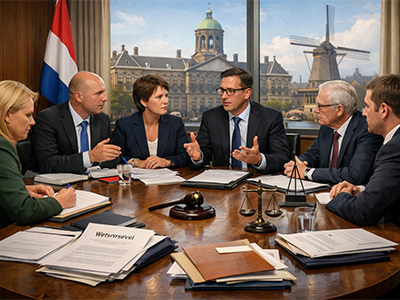
The Netherlands’ newly formed coalition government has outlined plans to impose a complete ban on gambling advertising and examine whether the number of online gambling licences should be reduced, marking a tougher policy direction for the sector. The proposals form part of a coalition agreement published on 30 January, following months of negotiations after last year’s general election produced no clear majority.

The three-party coalition brings together the centrist D66 Party, the conservative Christian Democrats, and the right-wing VVD Party. The alliance follows the collapse of the previous government led by Dick Schoof, which fell amid internal disputes over asylum policy. The new cabinet is expected to be sworn in later this month.

Coalition agreement sets strict tone on gambling

In its 67-page agreement, the minority government drew a direct comparison between gambling and sex work, stating that both are legal industries but vulnerable to criminal activity. The document framed its proposals as part of a broader effort to protect at-risk individuals.

“Online gambling and sex work are legal in the Netherlands, but they are also susceptible to crime and human trafficking. We want to protect vulnerable people in these sectors from profiteers,” the agreement said.

The coalition committed to reinforcing the duty of care required of licensed operators, intensifying enforcement against illegal gambling platforms, and implementing a full ban on online gambling advertising. It also confirmed that the government is considering restricting the total number of licences available to online gambling providers.

“We are strengthening the duty of care of online gambling providers, cracking down on illegal gambling sites, and introducing a complete advertising ban on online gambling. We are exploring limiting the number of licenses for online gambling sites.”

The previous government had planned to reform online gambling laws and introduce a new Gambling Act by the end of 2025. Those efforts stalled when the coalition collapsed, leaving regulatory changes unresolved until the new agreement was released last week.

Regulator notes political friction

The Dutch gambling regulator Kansspelautoriteit (KSA) has previously acknowledged tensions with policymakers on gambling reform. KSA chairman Michel Groothuizen said the regulator often faces resistance across the political spectrum.

“The industry is not too welcomed by most [political] parties. The analysis we come up with and measures we propose are seen as perhaps a bit too pragmatic,” he said.

Groothuizen has publicly opposed several ideas raised by politicians in the past, including raising the legal gambling age and implementing a total advertising ban. He also warned that the current coalition’s minority status could complicate the passage of new legislation, noting it is the first minority coalition in the Netherlands in more than a century.

Despite those challenges, he said lawmakers have shown willingness to engage with the regulator and discuss existing policy, which he viewed as a constructive development.

Industry warns of black market impact

Industry representatives have expressed concern that a complete advertising ban could weaken the regulated market. Gambling trade body VNLOK issued a warning that such a move could accelerate player migration to unlicensed operators.

In a statement published on Friday, VNLOK chairman Björn Fuchs said a total ban would undermine the foundations of Dutch gambling policy, which he described as “deliberately designed around an open, regulated market with strict requirements for duty of care, advertising and oversight”.

VNLOK cited data from the KSA showing that illegal gambling activity in the Netherlands is increasing. In October, the regulator reported that black market revenue had overtaken legal market revenue in the first half of 2025. Gross gaming revenue for licensed operators reached €600 million during that period, down from €697 million six months earlier, a decline the KSA partly attributed to new player protection measures such as deposit limits.

Top Baccarat casinos
Overall Rating: 97
Overall Rating: 96
Overall Rating: 95

Advertising and licensing history in focus

This is not the first time a comprehensive advertising ban has been discussed in the Netherlands. In July 2023, the government introduced strict limits on gambling promotion, banning advertisements on television, radio, and in print. Online advertising rules were also tightened to prevent targeting consumers under 24, and gambling sponsorships ended in the summer of 2025.

Licensing is also under renewed scrutiny as 2026 marks five years since the launch of the regulated iGaming market. Operators must renew their licences to continue operating. While speculation emerged last year that licences might not be renewed for companies with past compliance breaches, the KSA later dismissed that idea. Instead, the regulator said it would seek evidence of how operators addressed previous enforcement issues.

At the time, lawyer Justin Franssen said: “The gambling authority strives to make the reapplication process as smooth as possible.” VNLOK’s Fuchs added: “If you have a clean sheet, there are some hoops, but for various modules you can just send a declaration which states that you’re compliant.”

As the coalition’s proposals move toward debate, both regulators and industry stakeholders continue to warn that policy decisions could significantly influence the balance between the legal market and illegal operators.

Source:

“New Dutch coalition seeks to ban gambling ads and limit licences“, igamingbusiness.com, February 2, 2026.