
Lithuania Advances Player Card Plan and 36% Gambling Tax
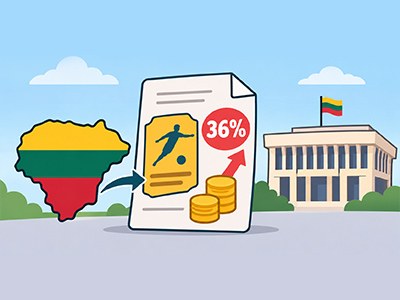
Lithuania's Ministry of Finance has submitted proposed amendments to the country's Gambling Law to parliament, introducing mandatory player cards for all gamblers and restrictions on cash payments at gambling venues. The proposals would also establish a centralised system for monitoring player activity, while a separate tax reform could increase the rate paid by the country's largest gambling operators to 36%.
The legislative package aims to strengthen gambling oversight and reduce gambling-related harm by allowing authorities to monitor customer activity across different operators. Under the proposed framework, players would need either a physical or digital identification card to access gambling services, whether online or at land-based establishments.
The Seimas began considering the player card legislation on 10 November, with the proposal now referred to its Budget and Finance Committee. Parliament is scheduled to revisit the bill on 17 December.
The government approved the proposals on 17 June, with most of the legislative changes expected to take effect on 1 May 2027. However, the mandatory player card and cashless payment requirements would only become effective on 1 January 2029.
Centralised Player Cards to Monitor Gambling Activity
Under the proposed system, every gambling customer would receive a player card linked to a centralised database recording deposits and withdrawals across licensed operators. The system would cover both online gambling accounts and transactions conducted at physical venues.
Players would also be able to establish personal financial and time limits through their cards. These restrictions would apply across the market, addressing a limitation in the existing regulatory framework, which requires individual operators to monitor customer activity only within their own platforms.
Rūta Carik, Deputy Minister at the Ministry of Finance, explained the reasoning behind the proposed changes:
“The current legal framework obliges gambling operators to apply responsible gambling measures in their activities and to ensure that a player cannot play longer or lose more money than the limits they have chosen. However, this obligation applies and works only at the level of a single gambling company and does not protect the player from continuing to gamble with other operators under the limits the player has set at those companies.”
The proposed legislation would also introduce additional financial checks for customers setting monthly loss limits above €20,000.
In these cases, gambling operators would have to verify the player's income before allowing them to participate. Acceptable documentation would include salary certificates from employers, annual income declarations, bank statements and evidence of dividend or investment earnings.
Customers unable to provide the required financial documentation would be prohibited from gambling under the proposed rules.
The introduction of mandatory player cards would coincide with the elimination of cash gambling payments at land-based establishments. All transactions would have to pass through official payment systems, giving authorities a clearer record of financial activity within the licensed market.
The ministry also intends to strengthen its ability to restrict access to illegal gambling services by allowing authorities to block websites that advertise unlicensed operators or provide links to their platforms.
Virginijus Daukšys, Head of the Gambling Supervision Service at the Ministry of Finance, said:
“The main goal of the changes is to reduce the accessibility of gambling and the harm to people’s mental health.”
The proposals come amid increasing gambling expenditure in Lithuania. Players lost €274 million in 2025, compared with €242 million the previous year.
The country's self-exclusion register had recorded more than 101,000 applications by 31 October 2026, although approximately 22,000 remained active. The register receives around 1,500 additional applications each month.
Men account for 84% of applicants, while approximately 80% fall within the 21-to-40 age group.
New Tax Structure Could Raise €36 Million
Alongside the player card legislation, the Ministry of Finance has circulated a separate proposal to increase gambling taxes for operators generating higher revenues.
The draft would introduce a progressive tax structure based on gross gaming revenue (GGR), retaining the existing 22% rate on the first €3 million generated by an operator.
Revenue exceeding that threshold would face higher rates, with the portion between €3 million and €5 million taxed at 29%. Any GGR above €5 million would attract a 36% rate.
The proposed changes would also affect lottery operators, whose tax rate would increase from 18% to 20%.
Based on gambling industry results from 2025, the ministry estimates that the revised taxation system could generate up to an additional €36 million for the state budget.
The new rates are expected to apply from 1 July 2027, with operators beginning to pay the revised taxes on their third-quarter results. Lithuanian National Radio and Television (LRT) reported that the ministry intends to submit the tax proposal to the government alongside the revised budget covering 2027 to 2029.
The tax initiative remains separate from the player card legislation, meaning both proposals must progress through their respective approval processes before implementation.
The proposed increases could have a significant effect on larger gambling companies, particularly those generating substantial revenue above the €5 million threshold.
Remote gambling already represents a considerable portion of the Lithuanian market. It accounted for approximately 78% of total GGR during the first half of 2026, when the country's gambling sector generated €153.6 million.
Top Poker casinos

Shazam Casino
Bonus
$ 2500
W/R: 35xB+D
No live dealer terms listed
Game Selection Roulette Blackjack Baccarat Poker Wheel Games Lottery
Software Providers Visionary iGaming, Betgames

DuckyLuck Casino
Bonus
$ 2500
+ 150 Free Spins
W/R: 30xB+D
No live dealer terms listed
Game Selection Roulette Blackjack Baccarat Poker
Software Providers Fresh Deck Studios

NewVegas Casino
Bonus
$ 3000
W/R: 35xB+D
No live dealer terms listed
Game Selection Roulette Blackjack Baccarat Poker
Software Providers Fresh Deck Studios
Gambling Industry Raises Concerns Over Proposed Restrictions
The proposed regulatory changes have encountered opposition from representatives of Lithuania's licensed gambling industry.
In a letter sent to the government and Ministry of Finance on 12 June, the Responsible Gambling Business Association (ALVA) requested that the player card proposal be returned for further revision.
The association represents four companies that collectively accounted for 60% of the Lithuanian gambling market in 2025. It argues that tighter restrictions on licensed gambling could encourage customers to use unregulated alternatives.
According to ALVA, illegal online gambling already represents at least one-third of the legal market. The organisation believes additional restrictions could increase this share by making unlicensed platforms more attractive to customers seeking fewer limitations.
Mindaugas Ardišauskas, Head of the Responsible Gambling Business Association, criticised the proposed framework, stating:
“The proposed regulation not only fails to prove its necessity and effectiveness, but also creates significant legal, technological, administrative and economic consequences that are not proportionate to the aims pursued.”
The association's objections focus on the potential consequences of introducing the system, including the legal and technical requirements operators would need to meet and the additional administrative costs associated with implementation.
The Ministry of Finance first presented the player card concept in April, describing it as the only permitted method of accessing gambling services in Lithuania from 2029.
The legislation now faces parliamentary scrutiny, with the Budget and Finance Committee responsible for examining the proposed amendments before further consideration by the Seimas. Parliament is expected to return to the bill in December.
Source:
“Lithuania sends player card bill to Seimas as tax plan targets 36% top rate“, europeangaming.eu, November 16, 2026.