




Discover Casinos
Discover Tables
Discover Providers
Discover Games
Discover Deposit Methods
Best Live Casinos
Popular In UK
Top Live Dealer Tables
Native Tables
Game Guides
Other Pages
Best Software Providers
Popular List
Best Payment Methods
Most Popular
Best Bonuses
Our Favourite Offers
Country Specific Pages
Popular List

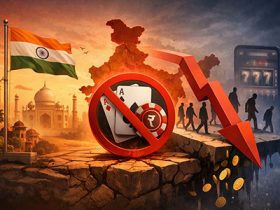
India RMG Ban Cuts User Interest by 11% in One Month

Posted on March 23, 2026 | 11:37 am
Indias-RMG-ban-triggers-11_-user-drop-data-reveals

India’s online gaming market recorded a sharp decline in engagement shortly after new legislation restricted real-money gaming activity. Fresh data indicates that user interest fell by nearly 11 percent within a single month following the rollout of the Promotion and Regulation of Online Gaming Act (PROGA), which came into force in August 2025 and prohibited games involving monetary stakes.

Analytics from Blask, which monitors user engagement across gaming brands, captured an immediate behavioural shift. The Blask Index dropped from 44.43 million in August to 39.57 million in September 2025, reflecting a rapid adjustment among players once the new rules took effect.


Read More

User Engagement Drops After Policy Shift

The decline was not limited to a single month, although the most significant change occurred early. In October 2025, the index showed a modest increase to 40.07 million, suggesting some level of continued activity. November brought a stronger rebound, with figures rising to 44.26 million, nearly reaching levels seen before the regulatory changes.

This recovery did not continue. By December, user interest fell again to 40.17 million, with January 2026 maintaining similar levels. The data points to a stabilisation phase where engagement persists but at a noticeably reduced baseline compared to the period before PROGA.

Speaking on the immediate impact, Ananay Jain, Partner and National Media & Entertainment Industry Leader at GT Bharat, said, “PROGA hit the real-money gaming industry like a switch being flipped. The moment banks and fintechs were barred from handling real money gaming (RMG) payments or ads, everything changed overnight.”

The shift in behaviour reflects structural changes across the ecosystem, as payment restrictions and advertising limitations disrupted how users accessed and interacted with gaming platforms.

Read More

Revenue Trends Mirror Engagement Decline

Alongside reduced user interest, estimated revenue figures also moved downward during the same timeframe. Blask’s Market Dynamics dataset shows that monthly revenue stood at $431.9 million in August 2025. By September, it had declined to $415.6 million, indicating an early response to the new regulatory environment.

The trend continued in October, when revenue slipped further to $410.2 million. November recorded a temporary improvement to $417.9 million, suggesting that both operators and users were adapting to the new conditions.

This rebound proved short-lived. December revenue dropped to $406.8 million, followed by $404.5 million in January 2026. Over a five-month period, the market shifted from levels above $431 million to just over $404 million, illustrating a gradual adjustment rather than a sudden collapse.

Jain noted the scale of disruption among major operators, stating, “Big RMG companies like Dream11, MPL, Games24x7, WinZO, and Gameskraft had to either shut down or completely rethink their cash-game offerings. MPL closed its entire cash gaming arm, and WinZO even moved its RMG business to the United States. These weren’t minor adjustments, they were survival moves.”

As companies transitioned away from cash-based formats, they encountered operational challenges, including layoffs, asset write-downs, and investment in new product directions that had yet to deliver immediate returns. Jain added, “It becomes evident how much the entire sector depended on user deposits.”

Top casinos

150% up to

₹40000

Overall Rating
92

100% up to

₹20000

Overall Rating
91
Read More

Offshore Activity Rises as Market Restructures

The regulatory framework introduced by PROGA reshaped not only domestic operations but also user behaviour beyond regulated channels. Restrictions on real-money gaming prompted many platforms to pivot toward alternative formats such as casual games, esports competitions, and entertainment-driven experiences without monetary stakes.

Tapasya Shukla, Founder and Managing Director of Zutsu, framed the shift as part of a broader transition. “As capital shifts from real-money gaming to publisher-backed esports ecosystems, and with India investing ₹15,000 crore ($1.63 billion) in animation, visual effects, gaming, comics – extended reality (AVGC-XR) alongside global titles like BGMI and Honor of Kings scaling locally, we’re entering a phase where gaming in India becomes a structured, monetisable entertainment economy,” she said.

At the same time, offshore platforms gained visibility. A survey conducted by CUTS International found that 83 percent of players in Tamil Nadu either continued or started using offshore betting sites after the ban, a significant increase compared to earlier levels. Prior to the restrictions, 67.8 percent of respondents had already engaged with such platforms alongside domestic options.

Rakesh Maheshwari, former Senior Director and GC Coordinator at MeitY, pointed to limitations in enforcement. “Right now, efforts like taxation and enforcement exist, but they aren’t enough. New apps keep emerging, making control difficult.”

He also addressed the broader regulatory approach, stating, “Ideally, the government should have taken a more structured approach in the bill, especially to address offshore gambling sites.” Expanding on this, he added, “The nature of the internet makes outright bans less effective, as offshore platforms operate beyond jurisdiction and are difficult to track or regulate.”

Reflecting on policy direction, Maheshwari said, “Rather than opting for an outright ban, a well-designed regulatory framework might have been a more practical approach.”

Despite the disruption, parts of the industry are repositioning. Companies are redirecting focus toward free-to-play models, esports ecosystems, and content-driven experiences. Jain described the transition as complex, noting, “PROGA has been something of a double-edged sword. While it tightened the rules, it also pushed companies toward clearer and potentially safer growth paths.”

He added, “With centralised governance and a strong nudge toward esports and social gaming, the industry is now naturally moving toward free-to-play models, ad-led revenues, and community-focused experiences.”

Further reinforcing this direction, Chandrima Mitra, Partner at DSK Legal, highlighted the growing role of competitive gaming, stating that esports continues to expand as distinctions between formats become clearer. “India has participated in esports global championships like the esports world cup.”

Jain concluded, “Esports is no longer a fallback option. It is emerging as a full-fledged media-sport powerhouse, driven by sponsorships, merchandise, and creator-led content.”

India’s gaming sector now operates under a redefined structure, with engagement and revenue stabilising at lower levels while new formats and offshore activity reshape the broader landscape.

Source:

India’s RMG ban triggers 11% user drop, data reveals, sigma.world, 18 March 2026

Read More